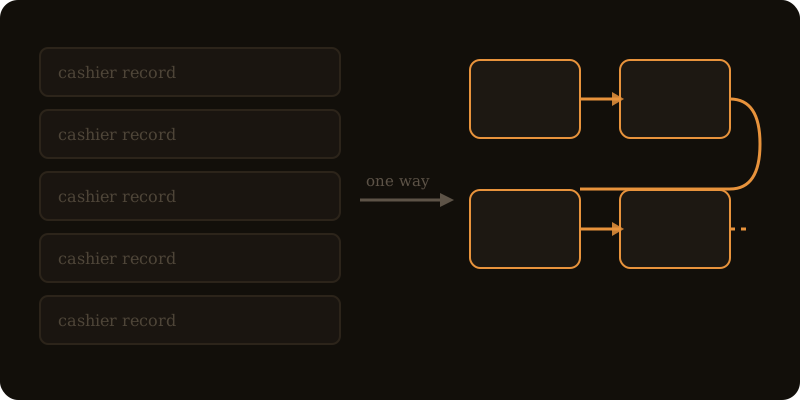
BitStarz is the only operator of these twelve whose own payments page names Lightning beside ordinary Bitcoin. Bitcoin appears as a row, and Lightning appears as its own row beside it. For a reader deciding whether to approach this cashier with BTC, that is a concrete piece of information rather than a slogan.
It is also narrow. A second row says the cashier recognises a second way for the coin to arrive; it says nothing about the lobby, the account checks or how an unusual case is handled. And it does not soften the one fact that governs the whole transaction: a Bitcoin payment, on either route, cannot be taken back once it has gone.
Why one coin gets two rows
The ordinary route writes a transaction onto the Bitcoin chain, where it is confirmed by blocks and is then permanent. Lightning is a second arrangement built on top of the same coin: payments move between parties who already hold a channel open, and only the opening and closing of that channel are written to the chain.
That is why a cashier lists them separately. They need different things from the sender -- an address in one case, an invoice in the other -- and a wallet that does one does not necessarily do the other. Choosing the row that matches the wallet in your hand is the whole decision, and it is made on the screen, not in advance.
Neither route has an undo
The on-chain route is irreversible for the reason the chain exists: a confirmed block is not rewritten on request, and there is no party standing between sender and recipient who could be asked. A Lightning payment settles between two parties in a moment and is likewise not something a desk reverses afterwards.
So the useful habit is identical on both: get it right before you send, because afterwards there is only the record. Read the destination the cashier gives you from the cashier, not from a note or a saved contact, and read it at the moment of sending rather than earlier in the session.
What this rules out is the mental model most people bring from cards and bank transfers, where a wrong payment is an annoyance with a procedure attached. Here a wrong payment is an outcome. The difference is worth feeling once before the first deposit rather than after it.
What the payments page does not say
It does not name networks for the other coins it lists, and for Bitcoin the two rows are the extent of it. This page therefore carries no welcome figure, no wagering condition, no licence detail and no deposit floor for BitStarz; none of those came from the operator, and nothing has been imported to stand in for them.
No score appears either. A brand that has been running a long time attracts a great many ratings, and the length of its history is not something a number out of ten can carry.
Picking the right row
If your coins sit in an ordinary Bitcoin wallet or on an exchange, the plain Bitcoin row is the one that will work. Lightning is for a wallet that speaks it, and a wallet that does not will have no way to pay an invoice at all.
Either way, keep what the transaction leaves behind. On-chain that is the transaction id; on Lightning it is the payment record your wallet keeps. Those are the only evidence a later conversation can be built on.
What this page states about BitStarz was read at bitstarz.com, the operator's own payments page. The cashier screen inside an account is the current version and wins over anything written here.
Questions readers ask about this operator
Does BitStarz name Bitcoin on its own pages?
Yes, on its payments page, where Bitcoin appears as a row and Lightning as a separate row beside it.
What is the difference between the two rows?
One writes the payment to the Bitcoin chain. The other settles it between parties holding an open channel, with only the channel recorded on the chain.
Is a Lightning payment reversible?
No. Neither route can be undone after the payment has been made, which is why the destination is checked before sending.
Why no wagering figure on this page?
Because the operator did not publish one where we could read it, and a number taken from an aggregator is not a fact.
Related pages
Where to go from this operator.
Payments — every statement the twelve make about the coin, side by side
Roobet — the operator before this one on the shelf, read the same way
Rollbit — the next operator on the shelf, with its own statement and its own gaps
Payment gone wrong — which failures a support desk can repair and which finished at broadcast