Bitcoin casino payments, read operator by operator
This page compares the twelve operators on one axis only: what each of them states, in its own
material, about taking Bitcoin. It is a comparison of documentation rather than a guide to
using a cashier, because the question this site answers is whether an operator is worth
approaching with the coin — not how the deposit form works once you are there.
Four of the twelve name a route for the coin. Six more name the coin alone. Two get no claim in
either direction: one did not open to us and the other is a name we could not tie to an operator. Under all of it sits the fact that shapes the whole
subject: once a transfer is broadcast, nobody can call it back.
What each of these cashiers puts in writing about the coin
Ten of the twelve say, on a page of their own, that they take Bitcoin. That is the whole of the agreement between them. Past it they diverge sharply, and the divergence is more useful than the agreement, because it tells a reader how much documentation they can expect to find when something is unclear.
Four name a route as well as the coin: Cloudbet, Stake, BitStarz, Duelbits. Six more name the coin and leave the route to the cashier screen: Roobet, Rollbit, BetFury, Sportsbet.io, Vave, BC.GAME. Two yielded no statement at all: CoinCasino and FortuneJack. One's own pages did not open to us, and the other is a name we could not tie to a specific operator. This site makes no claim about either, in either direction.
The pattern worth noticing is that the operators who document rails are also the ones who document what happens when a rail is wrong. Documentation comes in clumps: a cashier that troubles to publish a table usually troubles to publish the warning next to it.
Five kinds of statement, from the one that settles most to the one that settles least
A coin-and-route table is the strongest. It answers both halves of the question, and it can be read before an account exists. Three of these operators publish one: Cloudbet, Stake and Duelbits.
A closed coin list is next, and it is better than it looks. A list that ends without an "and more" has a boundary, and the boundary is where the information is: it lets a reader conclude something from an absence as well as from a presence. Three of these operators publish one, and two of the three attach a plain sentence about what happens to a coin that is not on it.
Then come an accepted-currency field in a page's own markup, a question block on a marketing page, and a description field. All three are the operator speaking, so all three count; none has a boundary, so none supports a conclusion from absence. At the bottom is the case where a site assembles its coin list in the browser and the page itself carries nothing, which leaves a reader with the cashier screen and no public document at all.
Why the send is the last moment anything can be changed
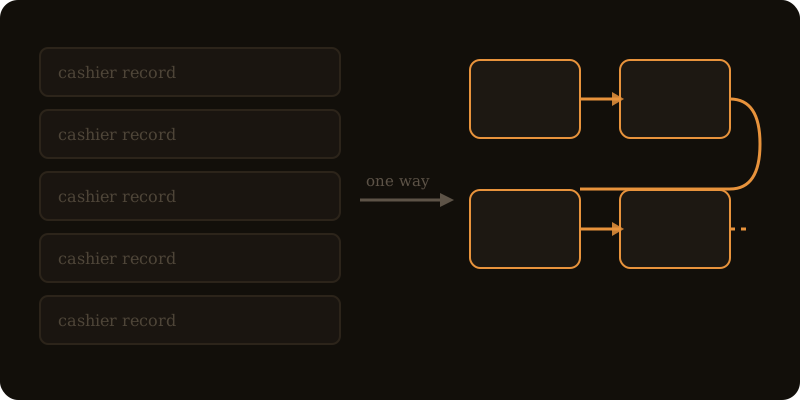
This is the part the documentation exists because of. A Bitcoin payment is signed by the key that holds the coins and broadcast to machines that do not know the sender; once a batch containing it has been written into the shared record, the rule every one of those machines follows is that the batch stands. No party in the arrangement has the authority to rewrite it, and no party has custody of the funds in between.
So a cashier's warning about a wrong route is not a liability clause. It is a description. The coins do not bounce, do not sit in a holding account and do not become somebody's problem to resolve; they land somewhere that has no process for returning them. The same is true of a mistyped address, with the additional unpleasantness that the destination may not exist as a wallet anybody controls.
What this does to the order of a careful deposit is the useful conclusion. Read the route on the screen even when you are confident; copy the address from the screen rather than from anywhere it has been stored; read the amount twice; and on a new account send a small amount before a large one, because a test transfer is the only rehearsal an irreversible payment offers.
What a cashier means when it says pending
Its own queue. Nothing more. A deposit marked pending has either not reached the number of record additions the operator wants to see, or it is sitting behind a check the operator performs. Both are the operator's policy and both are invisible from outside.
The word misleads because in every other payment context a pending transaction is one that has not fully happened yet and can sometimes be stopped. Here it has fully happened. The label describes a bookkeeping state on one side of the transfer, not the transfer.
The one failure that still has a remedy
Coins that arrived at the operator's own address and were not matched to an account. The money is where it was meant to be; the record did not follow. That is a bookkeeping problem, a support desk can fix bookkeeping, and the transaction id is what turns the request into something checkable.
Everything else on the irreversible side of the line is not a dispute but an outcome, and the most useful thing a page like this can do is say so plainly rather than imply that enough persistence will produce a different answer.
Why no minimum amounts appear on this site
Several of these operators publish deposit and withdrawal floors, and this site reproduces none of them. A floor is a figure an operator can change without telling anybody, and a stale floor on a page like this is worse than no figure: it would be read as current and acted on.
The version that matters is the one on the deposit screen at the moment of sending. The same reasoning keeps bonus amounts, wagering multiples and licence references off these pages, with the stronger reason that no operator stated those where we could read them at all.
What readers ask about paying in
Which of these operators names a rail for Bitcoin?
Four of them name at least one. The rest state the coin and leave the route to the deposit screen.
Why does this site quote operators rather than review sites?
Because a cashier's coin list is a fact about the cashier, and league tables disagree with each other about it.
What is the one case worth contacting support about?
Coins that reached the right address but were not matched to an account. That is a records problem and it has an answer.
Is a transfer ever held somewhere it can be recalled?
No. There is no intermediary holding it. Before signing it does not exist; after broadcast it is out of the sender's hands.
Why is no minimum deposit printed on this site?
Because an operator can change it without notice, and the figure that applies is the one on the screen at the time of sending.
What is worth reading on a deposit screen?
The route it names, whether the address is fresh, and whether the figure shown is what to send or what should arrive.
Related pages
Where the detail for one operator lives.
Operators — all twelve cards, each with the one statement its own pages make
Processing — the word pending, read literally, and who sets the fee on a transfer
Payment gone wrong — four ways it fails and the single one that can still be put right
Withdrawal records — what a transaction id proves, and what the cashier history does not